
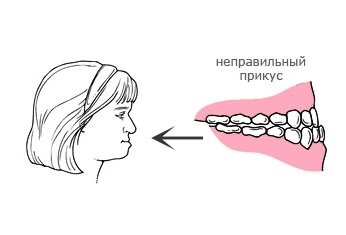
What causes misalignment?
Among the most common causes, both hereditary and acquired causes (improper dental care) can be noted. It is clear that hereditary causes can be eliminated with the help of a trip to the dentist, but the curvature of the teeth, which appeared as a result of bad habits, can be avoided at all, thanks to proper care. In addition to heredity (features of the structure of the facial structure and skull), in adults, malocclusion can also form at a later age (the result of prosthetics, fillings or tooth extraction).
The reasons for the formation of dentoalveolar anomalies and deformities can be different and there can be many of them. For example, the so-called bad habits can lead to crooked teeth:
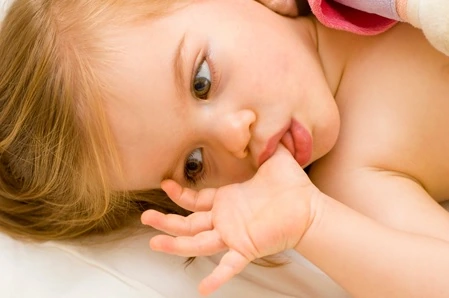
1. Sucking fingers, objects at an early age.
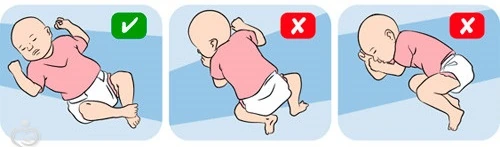
2. Wrong position of the head in a dream.
3. Wrong posture
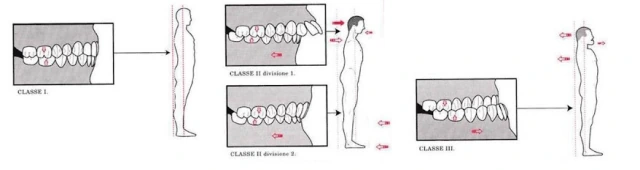
These and many other points can affect posture, resulting in impaired muscle function, which entails violations of the functional state of the dentoalveolar system. For example, the front teeth may begin to move forward, and the lower jaw move to the side or back.
Each of us in childhood was told by our parents that biting our nails, sucking or licking a pen, sucking our tongue is harmful. As a result of the above habits, there is a curvature of the corners of the mouth caused by tension, which takes as much as 2 years to eliminate. Remember how the teacher in kindergarten asked us to lie on our right side and put a fist under our cheek? So, it is strictly forbidden to do this, since the lower jaws are movable and as a result of any regular placement of any objects under it, symmetry and imbalance may be disturbed.
Also, the cause of malocclusion can be frequent SARS in childhood.
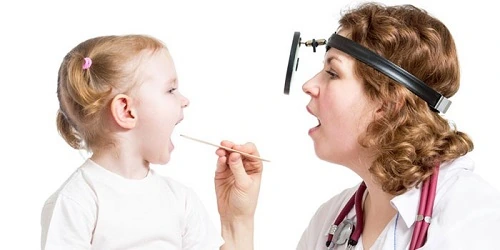
Another reason that can become a key factor in improper bite formation and weakening of the jaw muscles can be frequent colds in childhood. Frequent SARS can cause nasal congestion in children, as a result of which the child gets used to breathing through the mouth, and the lower jaw moves forward. Professional orthodontists who specialize in the treatment of crooked bite always pay attention to this feature in the first place. In such a situation, the dentist should refer the patient to an ENT. The important point is precisely the restoration of nasal breathing, otherwise, all the efforts that will be made to restore the bite will be in vain, since the problem will definitely return again.
What affects the wrong bite?
Many people think that malocclusion can only spoil the aesthetic appeal of the teeth or jaw. However, this opinion is misleading, due to the fact that due to an incorrect bite, the patient may face a huge variety of troubles. Many of us cannot even think that crooked teeth can “give” complications not only to the teeth and oral cavity, but also to the gastrointestinal tract, the musculoskeletal system and other vital organs. It is worth noting that the position of the jaw can also affect our posture. The human head has a weight of up to 6 kg and it is the bite that affects the correctness of its position. If the position of the head deviates by at least 3-4 centimeters from the norm, then the load on the spine increases by about 5 kilograms. The jaw can be displaced as a result of poorly installed fillings, as a result, about 136 chewing muscles are exposed to imbalance, which ensure the correct functioning of the lower jaw. So, each such mechanism can negatively affect the functioning of the spine, causing its curvature. Sometimes, in order to restore the correct posture, you just need to go to the dentist and change the fillings or crowns in order to ensure the correct jaw occlusion.
However, people who have a malocclusion problem may suffer from more than just curvature of the spine. As a result of the displacement of the lower jaw back, the development of cardiovascular diseases is often noted, as breathing is disturbed and oxygen starvation of the heart muscle occurs. Experts note that people who do not suffer from malocclusion, on average, live 20% longer than people with various anomalies of the jaw system.
Incorrect bite affects appearance
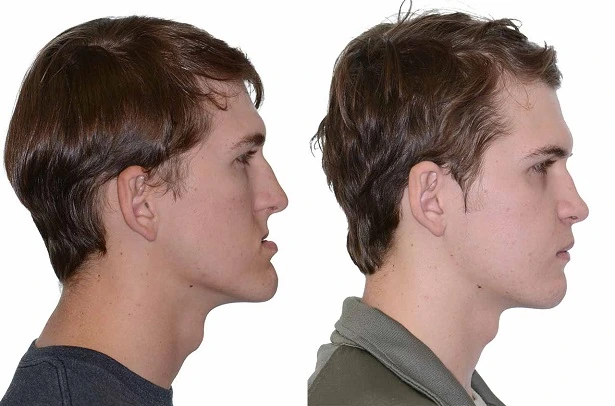
Incorrect bite can distort the face in different ways. There are the following types of malocclusion:
- Distal form. The chin appears small, and the face is frightened, sad, or surprised.
- Deep bite. It creates the effect of a small face.
- Sagging lower lip. When you have to constantly purse your lips.
- Mesial bite. The effect of a sad face and a heavy chin is created.
- Open bite. With an asymmetric face, when the mouth is constantly ajar. There may be problems with breathing, severe chapping of the lips, an increased predisposition to SARS, etc.
Malocclusion affects the spine and muscles
Scientists have long proven that even with slight deviations of the lower jaw to any side, a change in posture may occur. The latter is the cause of pain in various parts of the body (neck, spine, heels, etc.), and all this is due to malocclusion.
This point can be explained by the fact that the position of the jaw affects the degree of tension in the muscles of the neck, which cannot but affect the position of the shoulders and adjacent vertebral sections, which change the lower sections, and quite often the gait. If the jaw, shoulder blades and spine are in an abnormal position, then a person may experience constant nerve irritation, tension in one muscle, which in some situations can lead to pinching of peripheral blood vessels, causing headaches and noises and even fainting.
Malocclusion affects the joints, especially the TMJ (temporomandibular joint)
As a result of non-physiological closure of the jaws, dysfunction of the temporomandibular joint can form. The lower jaw is held by the muscular system, as well as the TMJ. Such a small lock can move back and forth, in different directions, as well as around its axis. The first two cervical vertebrae are associated with the position of the jaw and with the movement of the unique joint, and if the jaws do not properly close (occlusion of the teeth), there is an overstrain of the masticatory muscles, facial nerves and the temporomandibular joint.
Ultimately, there is increased tooth wear, chronic headaches, migraines, postural curvature, neck pain, sleep problems, and even narrowing of the airways (all consequences of TMJ dysfunction).
How to cure malocclusion?
If there are problems of the dentition, then in order to solve them, it is necessary to correct the malocclusion. What to do if malocclusion is a problem that causes discomfort associated not only with the appearance, but also with the performance of the chewing function? An orthodontist and neuromuscular dentists can solve the problem. However, it is important to remember that doctors can only correct the location of individual teeth or the dentition, but they cannot eliminate the anomalies in the structure of the jaw bones.
If there is a problem, it must be solved! A change of bite is possible at any age, especially since today there are many effective modern methods.
See also: Kyiv clinics offering «Braces».
Clinics offering this service
Dental clinic

Dental clinic