
Hover over the image and click the left mouse button
- Alveolar socket
- Dentin
- Gum
- Root canals
- Tooth roots
- Tooth crown
- Nerves
- Tooth cavity
- Crown cavity
- Cementum
- Jaw
- Tooth neck
- Tooth enamel
- Fissure


Tooth structure
To understand the cause of toothache and prevent it in the future, saving yourself from more serious problems, we provide you with a graphic diagram of tooth structure.
Alveolar socket
A cavity in the jawbone into which the tooth roots fit. The inner surface of the socket is covered with periodontal ligament, which anchors the tooth to the socket walls.
Dentin
The hard part of the tooth that protects the pulp from irritants. Dentin tissue is strong and dense, but is also susceptible to decay.
Gum
A mucous membrane that covers the alveolar processes of the upper and lower jaws and surrounds the tooth at its neck.
Root canals
The space inside the tooth roots. The canal ends in an opening at the root apex, through which the nerves and blood vessels that nourish the pulp pass.
Tooth roots
Hold the tooth in the alveolus (socket). The number of roots varies from 1 to 4, depending on the tooth.
Tooth crown
The main part of the tooth, which is covered with enamel.
Nerves
Independent processes of neurons responsible for transmitting the pain impulse.
Tooth cavity
Filled with pulp, through which blood vessels and nerves pass. The cavity is divided into the crown cavity and the root canal.
Crown cavity
The upper inner part of the tooth. Its lower part continues into the root canals.
Cementum
A thin layer covering the tooth root that connects to the enamel near the tooth neck. It helps firmly anchor the tooth in the bone socket.
Jaw
Forms the base to which the teeth are attached inside the mouth. The upper jaw is fixed and forms the cheekbones, the lower jaw is mobile and performs biting and chewing.
Tooth neck
Covered by the gum, located in the middle of the tooth and separates the crown from the root. Gum recession exposing the neck is a common cause of dental problems.
Tooth enamel
The protective, hardest mineralized outer layer of the tooth. Consists of three components: minerals, water and organic matter. If the enamel is damaged, microorganisms penetrate into the dentin, destroy it and reach the pulp, accelerating tooth decay.
Fissure
A groove on the chewing surface of the tooth, the first site where dental caries typically develops. Fissure sealing is performed for protection.
Tooth granuloma
A small but dense formation at the root apex, a fluid-filled capsule consisting of dead epithelial cells and microorganisms. The main cause is a chronic dental disease.
Gingivitis
Gingivitis is inflammation of the gums. A common periodontal disease. Symptoms of gingivitis include inflammation, bleeding, and redness of the gums.
Tartar
A hard, dark-colored deposit on the tooth surface formed from food debris, dead cells, bacteria and microorganisms. Tartar is removed by professional cleaning as soon as it appears.
Caries
The gradual destruction of the tooth — enamel and dentin. Leads to the formation of a cavity in the tooth tissue.
Tooth cyst
A capsular growth made of dead cells and bacteria. It is usually diagnosed only through dental X-rays, as it may show no direct symptoms.
Periodontitis
An inflammatory disease of the tooth tissues, gums and muscles. More aggressive than periodontal disease, it can progress rapidly and lead to tooth loss within a few years.
Periodontal disease
A dystrophic disease of the tissue surrounding the tooth. It is a disorder of mineral metabolism in the bone and soft tissues of the jaw. Most often detected on X-rays at the dentist's office.
Periodontium
A severe consequence of neglected, untreated caries, when the inflammatory process has already penetrated deep into the soft tissues of the tooth.
Pulpitis
Inflammation of the tooth pulp, informally called the "nerve". Pulpitis causes pain during both day and night. It develops from neglected caries.
Gumboil
The appearance of a swelling on the gum near the tooth root. Characterized by fluid accumulation in the tooth tissues with the release of purulent content.
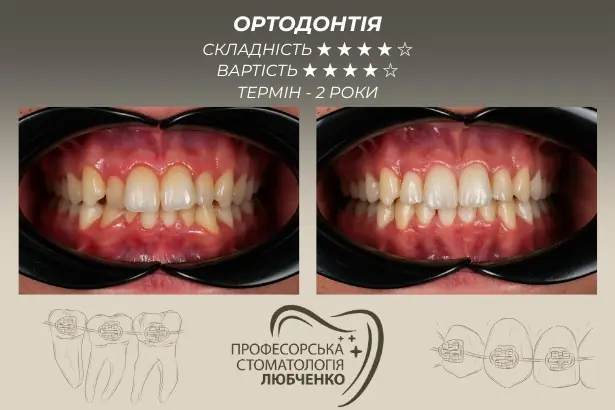
Braces
A system for correcting bite and aligning crooked teeth. Suitable for people of any age. The minimum wearing period is 1 year.
Veneers
Thin plates placed on the front surface of the teeth to address damage, discoloration, color change, correction, or gaps between front teeth.
Crown
A construction, a micro-prosthesis that replicates the anatomical shape and covers a damaged tooth that cannot be treated otherwise. A crown can also change the appearance and shape of the tooth.
Implant
A screw-shaped titanium structure embedded in the bone, serving as a support for a future crown or denture. Allows restoring lost teeth without damaging the neighboring ones.
Skyces and rhinestones
A decorative embellishment for the tooth. Besides decoration, it can smooth out small visible defects on the tooth. Popular among young people.
Additional information when milk teeth erupt, when they fall out and when permanent teeth appear can be viewed on the graph:
Everyone dreams of a delightful, bewitching smile. But there are few people nowadays who possess it by nature. But a smile, a correct bite, pink gums are the main signs of health. But many of us do not even think about how the tooth is arranged and only out of urgent need ask where and why it hurts.
General idea of the structure of the tooth
A tooth is an organ with bone formation that performs the functions of mechanical processing of food taken. And so that the unknown about its structure does not lead to fear during pain, experts recommend that you familiarize yourself with the basis of the structure. Their healthy condition is an indicator of a good and varied human diet, and therefore it is important to seek help in a timely manner for any inflammation. At birth, children develop milk teeth, which are replaced by molars as they grow up. Adults have an average of 28 to 32 teeth, where 4 of them are classified as wisdom teeth, which may be missing for some people for a long time.
In dentistry, it is customary to distinguish between teeth by main types, such as canines, incisors, small molars (premolars), large molars (molars). From school knowledge, many people know that a tooth consists of three main parts, like a crown, root, neck.
The crown is located above the gum, and in the deepening of the jaw in the alveolus there is a root, which does not always have a generally accepted amount. And in the gap between the root and the crown is the neck. When examining a tooth in section, its layered structure is noted, which is represented on the outside by enamel, and inside by the listed components.
Varieties of teeth
There are several types of teeth in the upper jaw, such as:
- lateral and central incisors;
- fangs located on the sides of the jaw;
- first, second premolars;
- first, second molars;
- third molar (wisdom tooth).
In the lower jaw, too, all teeth are subdivided into similar types, similar to the upper jaw, but with some differences in structure. The smallest tooth is the central incisor, in which the lingual part is concave and the labial is slightly convex. It has a small root. The lateral incisors are slightly larger than the central incisor, but they have a narrow crown and a single root with longitudinal grooves. The canine has no special differences from the structure of similar teeth in the upper jaw, but is represented by a narrower shape. The premolars differ in size, where the second is larger than the first due to the equally developed two tubercles. The roots are similar in structure. The first, second and third molars differ only in the number and shape of the tubercles that serve to chew food. Wisdom teeth have several types of differences, which depend on the individual characteristics of their development.
Components of tissue
The composition of the tooth includes four tissues, such as: enamel, dentin, pulp and cementum. All of them perform their specific functions. Enamel is characterized as a durable tissue of the human body, containing a large amount of mineral salts, inorganic, organic substances, and capable of withstanding resistance of various impact forces. Dentin is softer tissue, but harder than bone. Nerves, blood vessels, cellular elements are contained in the pulp. The thin layer that covers the root and connects to the enamel near the neck is called cementum. Its location may be near the enamel, layered on it, or located at its end.
Each person’s teeth have their own distinctive features in shape, size, color, presence of roots and other features.