
Who is an orthodontist?
An orthodontist deals with correcting crooked teeth and malocclusion.
What is included in the competence of a dentist-orthodontist?
The competence of the dentist-orthodontist includes the correction of bite and treatment of individual teeth with an unnatural arrangement. In the work of a doctor of this specialization, various orthodontic devices are used, for example, braces, plates, trainers, mouth guards, etc. Orthodontists also specialize in eliminating such bad childhood habits as constant sucking of fingers, prolonged use of nipples, the habit of breathing through the mouth, etc. And so, the dentist-orthodontist helps to cope with:
- uneven teeth
- crooked dentition
- interdental gaps
- children’s mouth breathing
- children’s habit of thumb sucking and other dental problems.
Reasons to see an orthodontist?
The reasons for visiting the orthodontist can be both the usual curvature of the dentition, and more complex cases, when the wrong bite and the wrong position of the teeth cause the development of caries, the rapid erasure of tooth enamel, as well as violations in the structure of the temporomandibular joint.
Methods for Diagnosing Orthodontic Problems
When receiving a dentist-orthodontist, first of all, an external examination determines the proportionality of the face, after which it proceeds to examine the patient’s oral cavity.
In addition to the examination, the doctor uses for diagnosis:
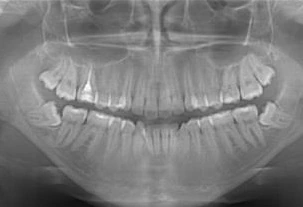
- examination with a radiovisiograph or orthopantomograph
- takes impressions for making diagnostic models, etc.
What are the types of malocclusion?
A deep bite is when the upper teeth more than half overlap the surface of the lower teeth.
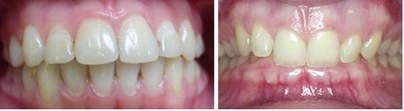
An open bite is when most of the teeth in the upper and lower jaws do not meet.
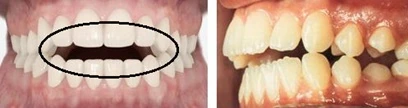
Distal bite – the lower jaw is underdeveloped or the upper jaw is overdeveloped, as a result of which, when the dentition is closed, the upper front teeth are abnormally advanced in relation to the lower ones.
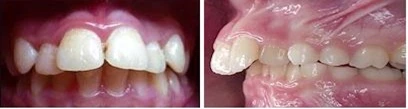
An underbite is when the lower jawbone protrudes significantly forward in relation to the upper.
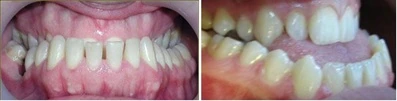
Crossbite – the incorrect position of the jaws or teeth (or both) in the horizontal plane.
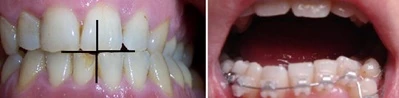
Dystopia – the tooth is displaced towards the cheek, tongue or rotates around its axis (the tooth is not in its place).

Types of orthodontic appliances
Depending on the problem requiring treatment, as well as the severity of a particular problem, the orthodontist may prescribe the use of the following types of devices:
- corrective, allowing you to effectively deal with the incorrect position of free-standing teeth
- squeezing, allowing to narrow the dentition, reducing the gaps between the teeth
- stimulating the growth of the alveolar process and teeth
- expanding, helping to increase the distance between the teeth and prevent their displacement
- combined, aimed not only at correcting or stimulating the growth of teeth and the alveolar process, but also at expanding the dentition
- retention, allowing to exclude the re-development of orthodontic problems.
Bracket systems
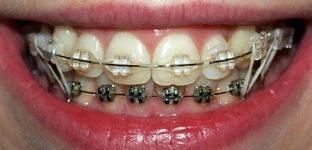
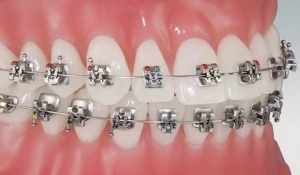
This is the most famous and popular method of correcting malocclusion. Braces are an orthodontic device consisting of a series of brackets that are attached to the surface of each tooth and connected to each other by a special arc. The most traditionally used metal braces, they allow you to correct significant anomalies of the dentition.
 Read more: Types of braces
How do braces work?
 Video: How braces work
The principle of operation of braces is based on metal with shape memory. Braces have a certain configuration, then they are installed on improperly grown teeth and these devices tend to return to their original shape, moving the teeth along with them.
If you decide to get braces, then you will have to visit the dentist regularly. The doctor during the treatment will monitor the effectiveness, if necessary, make the necessary adjustments. Wearing braces is a long process and can take several years.
Before installing a bracket system, it is necessary to carry out a comprehensive treatment of teeth and gums, clean the dentition from plaque, and after the braces are removed, you need to re-brush your teeth.
At what age can you get braces?
Treatment with a bracket system is possible already at the age of 9-10, when not all teeth have yet been replaced, but the age of 12-13 years is considered optimal, since the teeth are actively growing, and the effect is the best.
But this does not mean that braces cannot be installed at the age of 30, it just takes longer to heal.
How long do you need to wear braces?
Treatment lasts from 1.5 to 2 years, depending on the degree of the disorder.
What braces in Kyiv to choose? Types, difference.
In our time, modern medicine has made the process of wearing braces more convenient, and sometimes even almost invisible, so there are two options for braces: both external and internal.
– external braces at the request of the patient can be made of ceramic, sapphire, plastic and be completely transparent.
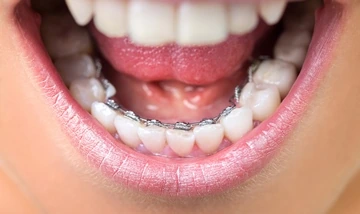
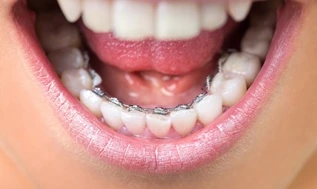
– internal braces are attached to the invisible side of the teeth, from the position of the tongue, and therefore are almost invisible to others.
|
Properties |
External braces |
Internal braces |
|
Comfort and habit |
Braces can scratch or rub lips or cheeks for 1-2 weeks. Habituation occurs in 1-2 weeks. |
Braces can rub the tongue for 2-3 weeks. Habituation occurs in 3-4 weeks. |
|
Influence on diction |
Do not affect diction. |
They can change diction, but not in all cases. The pronunciation of 1-2 sounds changes for a period of 2-4 weeks after the installation of braces. |
|
Security |
For enamel: more risk of demineralization spots (initial white spot caries) around braces with poor hygiene. The spots can last a lifetime and are visible when you smile. |
For enamel: there is practically no risk of demineralization stains due to good self-cleaning properties (tongue and large amounts of saliva). If such a stain appears, no one will see it except your dentist. |
|
Duration of treatment |
Treatment lasts from 1.5 to 2 years, depending on the degree of the disorder |
Treatment lasts from 1.5 to 2 years, depending on the degree of the disorder |
|
Price |
Cheaper than internal braces |
More expensive than external braces, due to the technical manufacture of braces, which, depending on the chosen braces, ranges from 1000 to 2500 euros. |
retainers
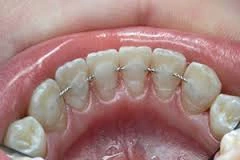
After the braces are removed, retainers are placed on the teeth.
Retainers are a special wire that prevents the teeth from moving back to their original position. Retainers are invisible to others and the patient himself, but you cannot do without them even in the simplest case.
Records
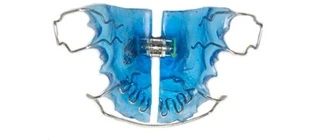
Removable plates on the teeth are made of high quality plastic. They are absolutely harmless, as they do not contain harmful and abrasive substances.
The plates that are put on the dentition do not need to be worn all the time. The period of daily wearing of the plates is determined by your doctor.
Plates are a good way to correct bite for children and adolescents under 13 years of age with minor complications in the structure of the dentition, for other cases, this method is ineffective.
Trainer
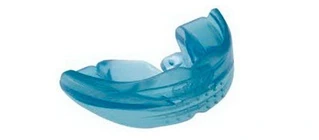
This is a poorly used method of bite correction. This device corrects not only the position of the teeth, but also the position of the tongue. The trainer is usually put on for four hours a day, but its use severely limits a person in communication. That is why today this method is rarely used and only in the treatment of children.
Caps
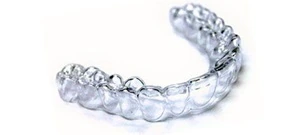
Mouthguards are an alternative to braces for minor crooked teeth. Caps are worn on the dentition, but at the same time they are completely invisible, as they are made of special materials that mimic the natural color of the teeth. Treatment with caps is quite long. Mouthguards are made of a thin material that takes the shape of your teeth, so they are also almost invisible physically. Mouthguards are worn all the time, except for the period of eating and brushing your teeth.
Surgery
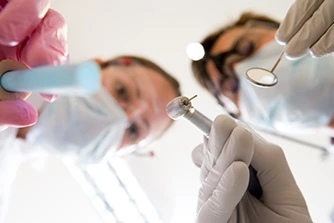
If the case of malocclusion is complex, then dentists resort to surgical intervention, this is when the structure of the bones of the skull is incorrect, the palate expands, the removal of one or more teeth, the movement of the tooth along with the bone.
Correction of the bite is best done before the age of 13, when the child’s dentition is more “plastic” and easier to influence. But this in no way means that an adult cannot correct an overbite! Modern technologies, such as braces and caps, are designed to correct bite in adult patients.
There is no age when it would be too late to correct an incorrect bite.
Precautions for the Development of Orthodontic Problems
If it is almost impossible to avoid congenital or hereditary orthodontic anomalies, and sooner or later a person will have to deal with their elimination, then acquired anomalies can be easily prevented. So, the best orthodontists recommend:
- Practice oral hygiene twice a day, standing in front of a mirror and carefully cleaning every corner of your mouth with a regular toothbrush for at least 10 minutes;
- during treatment with an orthodontist, it is necessary to stop eating excessively hard foods, such as nuts, seeds, etc.;
- when eating hard vegetables or fruits, they should be carefully chopped, evenly, like meat or any other products that need to be bitten off;
- viscous products should also be excluded, as they can harm the integrity of the orthodontic appliance;
- it is necessary to monitor the temperature of the food consumed, it should not be excessively cold or hot, because low and high temperatures harm not only natural tooth enamel, but also the materials of the apparatus itself;
- products containing natural or artificial colors should be limited and, at best, completely eliminated.
Advice from an orthodontist
Also, a qualified orthodontist warns his patients that during the first week there may be some discomfort, sometimes even injury to the cheeks and oral mucosa. To avoid such unpleasant consequences, for the first time, the doctor covers the protruding parts of the apparatus with special wax. If you have any other problems with orthodontic constructions, you should immediately contact your doctor.
Search for dentistry in Kiev by service: put braces
Search for a dentist in Kiev: dentist orthodontist
Clinics offering this service
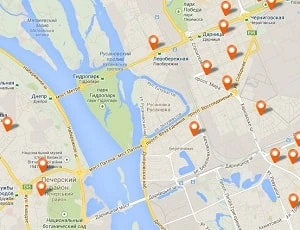
Kyiv, avenue Heroes of Stalingrad, 4, building 6.
Dental clinic
Kyiv, 70 40th Anniversary of October Avenue, 3rd floor, office 338.