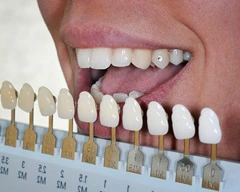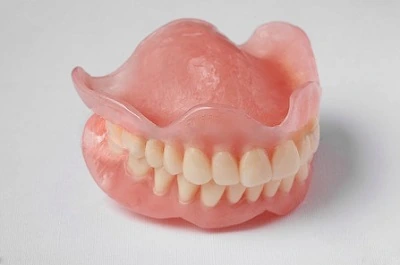

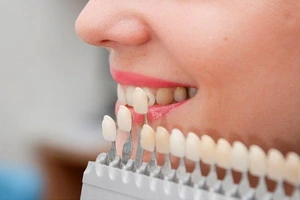
Over the years, flaws, chips appear on the enamel, the appearance deteriorates, so you have to turn to a doctor who can restore your teeth, make them perfect and white. Dental restoration involves a procedure that improves the appearance of teeth. All stages are carried out using veneers and filling materials.
Dental restoration methods
There are two types of restoration: direct and indirect.
- Direct view – it is also a composite one – the imposition of a filling material in accordance with the technologies and use of this material. The advantage of the direct method of tooth restoration: the speed of work from 1 hour to 3 hours, depending on the volume, working conditions and requirements for restoration.
- Indirect view – laboratory-made restoration outside the patient’s mouth. An impression is taken, according to which the dental technician in the laboratory makes a veneer from ceramic mass or composites, after which the veneer is glued to the tooth. The disadvantage of the indirect type of restoration is several stages of visiting the dentist.
Disadvantages of dental restoration
Restoration from filling materials tends to darken over time, and also lose their luster compared to healthy tooth enamel. On chewing teeth, these defects may not be visible and this is not so scary regarding the aesthetics of the teeth, but on the front teeth it is noticeable and unpleasant. Therefore, you have to visit the dentist every few years to remove these defects.
The restoration can break when the tooth is destroyed by more than 1/2 and if the nerve is removed (depulpated), the risk of breakage is much greater than that of natural teeth. It happens especially often when the tooth has been restored from the root. With a large load on the tooth, a tooth breaks off, sometimes a fracture of the tooth root, which leads to its subsequent removal.
Alternative methods of dental restoration
1. Veneers
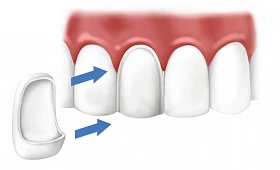
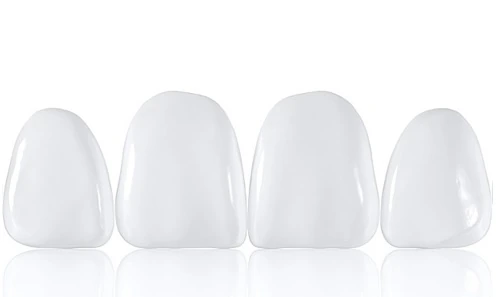
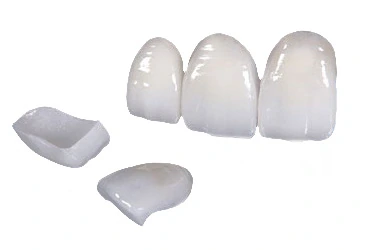
Veneers are thin ceramic plates 0.5 – 0.7 mm, which cover the front surface of the tooth. Veneers will be used if your front tooth is destroyed only from the front side, and the inside of the tooth is not destroyed much, then ceramic veneers are the best option, because ceramics do not darken at all and do not lose their luster. The only downside to veneers is their price.
Indications for the use of veneers:
- ugly tooth shape
- an ugly tooth color that cannot be improved by whitening
- chipped incisal edge
- small gaps between front teeth
- Moderately crooked teeth that can be corrected without orthodontic treatment.
Wiener contraindications:
- increased abrasion of teeth (grade 2 and above)
- absence of chewing teeth (sixth, seventh)
- extreme sports (boxing or other contact sports)
- bad habits of biting threads or nails, opening beer with teeth
- if the tooth was treated with resorcinol-formalin
- strong destruction of the tooth surface from the inside (lingual)
- the presence of a filling of medium or large size on the lingual surface of the tooth
- malocclusion of teeth (direct or reverse)
- Too little enamel on the front teeth
Advice:
If you need to restore several teeth at once, one of which turned out to be destroyed by more than ½ of a tooth, then a porcelain crown can be applied to a heavily damaged tooth, and porcelain veneers can be applied to a less damaged tooth, then these teeth will look exactly the same.
2. Crowns
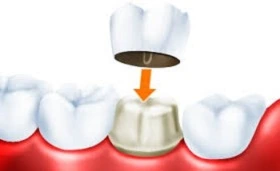
A crown is an orthopedic structure, a micro-prosthesis that restores the anatomical shape of a tooth, providing chewing function and aesthetics. The crown is placed on the tooth if it is destroyed by more than 1/2, if it is also depulped (the nerve is removed). There are metal-ceramic and ceramic crowns. Ceramic crowns are almost impossible to distinguish from the patient’s own teeth, so their cost is more expensive than metal-ceramic ones.
Advantages of crowns:
Acceptable Aesthetics – Porcelain-fused-to-metal crowns are well made and will largely match the appearance of your natural teeth, and will be cheaper in price. Ceramic crowns will be almost invisible with natural teeth, but they will also be more expensive.
Durability and strength – structural strength and ceramic lining is not subject to caries or abrasion. Sometimes there may be small chips of the ceramic mass, but these are rare cases.
Disadvantages of crowns:
Grinding of the volume of the tooth – therefore, it is advisable to give preference to veneers when restoring the front teeth, to use restorative tabs when restoring chewing teeth.
Tooth depulpation (nerve removal) – it is only possible to keep large molars alive, they have a large crown size and a large volume of hard tissues (enamel and dentin). If possible, it is necessary to leave the teeth under the crowns – alive, this leads to less destruction of them, respectively, they can last longer.
3. Tabs
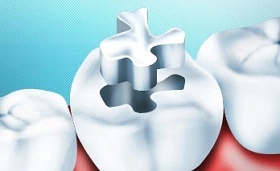
An inlay is a filling, only made in a laboratory. If you need to restore a lateral chewing tooth, then a restorative inlay can serve as an alternative for restoration. Ceramic inlays are superior to restorations in terms of reliability, service life, and aesthetics.
Many dentists advise restoring severely damaged teeth with restorations, since with a restoration insert they lose their earnings, giving it to prosthetists.
Advantages of inlays over fillings:
1. High aesthetics of ceramic inlays.
Ceramic inlays most fully match the color and structure of tooth enamel, due to this, the teeth are absolutely indistinguishable from real teeth. In addition, ceramic is a timeless material and its aesthetics are guaranteed for a lifetime. Fillings made of composite materials after 2-4 years darken and fade and lose their luster.
2. Quality and reliability of ceramic inlays.
Of great importance for the duration of service life is the size of the gap between the tooth and the artificial structure (inlay, filling). The joint border is the most vulnerable place, in which secondary caries most often occurs.
Prosthetics with inlays allows you to achieve a gap between the tooth and the inlay in microns – so precisely, the inlay is made to fit the size of the tooth defect. Fillings have similar indicators hundreds of times worse, and therefore caries often occurs on the border between the filling and the tooth. Therefore, the service life of inlays is more than 10 years, and polymer fillings – an average of only 3-4 years.
Lack of tabs before fillings:
The cost of inlays, due to the high cost and complexity of manufacturing, significantly exceeds the cost of traditional fillings.
Dentists that carry out the restoration of teeth in Kiev
Clinics offering this service
Dental clinic

Kyiv, str. Mykola Mikhnovsky, 14-16, section 3.