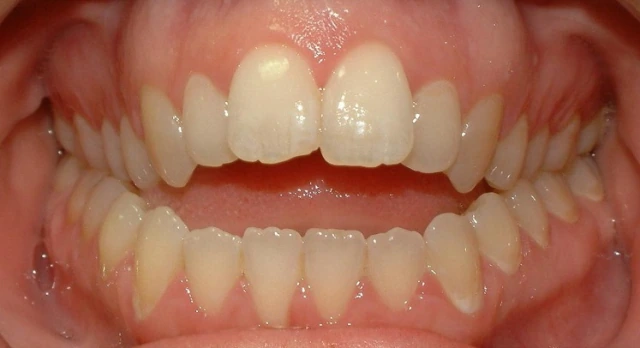

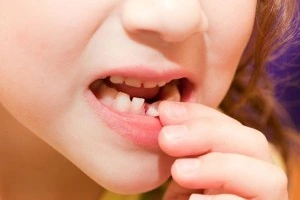
Replacing milk teeth with permanent teeth is an inevitable and natural process. The eruption of the first teeth occurs in the period from 6 to 9 months, when the baby’s diet expands significantly. During this period, the baby’s jaw is small, as are the teeth themselves, and when there is a transition to an adult diet, due to their fragility, milk teeth cease to cope with the loads. In addition, the child’s jaw is also growing (there is an increase in the interdental spaces). So, there is a resorption of the roots of milk teeth, as a result of which they loosen and fall out. In this way, space is freed up for the growth of strong permanent teeth.
It is almost impossible to predict when the change of milk teeth to permanent ones will begin, since this process is purely individual. The process of loss of milk teeth is affected by the rate of development of the body as a whole and genetic predisposition. However, dentists talk about a certain time frame when temporary teeth fall out and the growth of molars begins. It is also worth noting that nature “laid” a certain growth of new teeth in order.

How do baby teeth fall out?
In the life of every baby, there comes a moment when the milk teeth begin to stagger, as a result of which it falls out, and in place of the milk tooth a new, indigenous one is formed. In conditions of obtaining the required amount of vitamins and minerals, this process can occur much faster.
The development of the rudiments of the molars occurs along with the milk teeth, however, after some time, they are separated by bone tissue. During the germination of molars, the root system of temporary teeth dissolves and when the process reaches the neck of the tooth, loss occurs.
You can find out in more detail when milk teeth fall out on the vector graphics, link below.
How many milk teeth should be?
Upon reaching the age of 2.5 years, each child has 20 milk teeth, which are located on each jaw symmetrically to each other (10 pieces each). On the upper and lower rows there are 2 molars, canines, lateral incisors, 2 central incisors. Quite rare are situations when a child does not have the rudiments of some milk teeth (such a pathology can only be confirmed by an experienced dentist not earlier than 15 months of age of the child).
How to take care of your teeth?
During the period of loss of temporary teeth in children, fathers and mothers can face many problems (it is worth considering the age of children, because at 10 years old, he is more independent than at 5).
When it comes to oral hygiene, dentists recommend:
- Brush your teeth 2 times a day (if possible, after each meal).
- Rinse your mouth with special rinses and herbal decoctions (preferably after each meal)
- Undergo preventive examinations with a doctor so that you can track the moment of growth and condition of the teeth. If caries or abnormal growth of teeth is detected, then a trip to the dental center is mandatory.
- Perform fissure sealing (recommended to prevent the appearance and development of caries).
As a rule, during the loss of temporary teeth, there may be mild bleeding, which disappears after a few minutes. If the bleeding cannot be stopped, it is necessary to make an unscheduled visit to the doctor in order to rule out a problem with blood clotting.
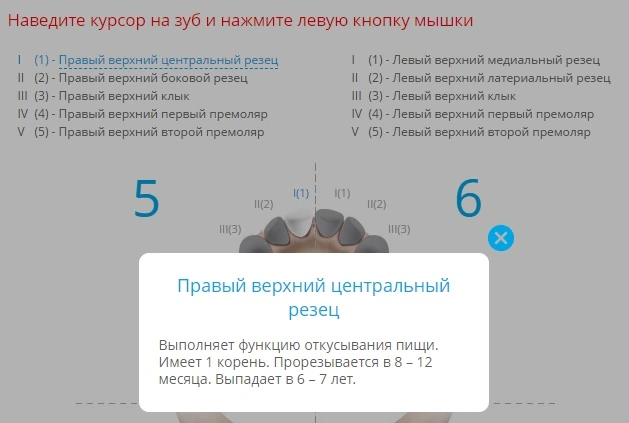
In more detail, when milk teeth erupt, when they fall out, the structure of the tooth can be seen on the graph:
See also: Kyiv clinics offering «Children’s dentistry».
Clinics offering this service
Dental clinic

Kyiv, st. Irpenskaya, 78A.
Dental clinic
Kyiv, st. Truskavetska 2-A ( LCD RiverStone)