
Interesting!
Interestingly, the formation of milk teeth begins even when the baby is in the womb, and after birth, permanent teeth begin to develop in the gums. This process is quite lengthy and exciting. It is worth noting that normally, an adult has 32 teeth (16 each in the upper and lower jaws). However, if we talk about small children, then they have 12 less teeth (20 pieces). With the first loss of their milk teeth, the child encounters when the process of formation of permanent teeth in the gum is completed. So, permanent teeth begin to erupt, thereby displacing milk teeth.

Quite often, parents worry about possible pain when changing teeth in a child. However, experts recommend calming down, because according to statistics, in 95% of cases, molars erupt with little or no pain. There is a resorption of the roots of milk teeth, and they simply fall out in a natural way. Often, first of all, the lower teeth change, however, it will be difficult to predict in what sequence they will fall out and new teeth will erupt in your baby (the question is purely individual).
Experts divide permanent teeth into 2 groups:
– Replacement teeth (those teeth that have similar milk teeth). These teeth are premolars, canines and incisors.
– Additional (those teeth that do not have predecessors). All teeth in this group are represented by molars.
Milk and permanent teeth and their difference.
Despite the fact that the structure of milk and molars is identical, they still have a number of differences:
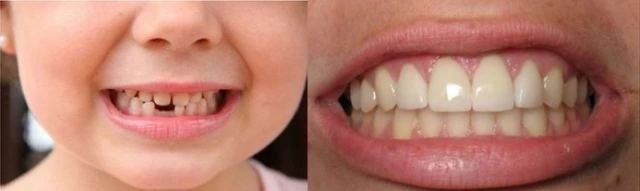
- Temporary teeth have a lighter shade of enamel compared to molars (light yellow enamel).
- Molar teeth are more dense.
- The pulp of temporary teeth is large, and the thickness of the walls of dense tissues is thinner.
- Molar teeth are large (width, less than length).
When are permanent teeth formed?
The eruption of molars begins at about 6 years of age (the appearance of the first molars).
- The eruption of the medial incisors occurs at the age of 6 to 8 years
- Eruption of the lateral incisors occurs at the age of 8 to 9 years
- Teething of fangs occurs at the age of 10 to 11 years
- Eruption of premolars occurs at the age of 9 to 12 years
- The eruption of the second molars occurs at the age of 12 to 13 years.
It is noted that the age at which all 32 teeth grow in a person varies in a very wide range.
Symptoms of eruption of permanent teeth.
The first symptom is an increase in the size of the jaw. If the gaps between the milk teeth are small enough, then their replacement with permanent teeth will begin very soon, since the body has already created all the conditions necessary for growth.

The first molars can announce their appearance quite “loudly”. This period can bring a lot of pain to the child. Children whose first permanent teeth erupt do not sleep well, become capricious, irritable. In some cases, even loss of appetite is possible. Also among the symptoms of teething permanent teeth may be: fever, cough and runny nose.
In what order do the molars erupt?
Many mothers and fathers believe that the first permanent teeth that appear in a child’s mouth are the incisors that grow to replace the milk teeth. However, this is misleading. Before the temporary teeth fall out, in children aged 5-6 years, the first molars begin to come out, which are not present in the milk bite.
In the future, the formation of a permanent occlusion occurs almost according to the sequence of eruption of temporary teeth:
- The appearance of the lower, and then the upper central incisors.
- The appearance of lateral incisors on both jaws.
- The appearance of the upper and lower first premolars.
- The appearance of fangs.
- The appearance of the second and third molars.
It is worth noting that such a sequence of appearance of permanent teeth in children is not accidental. Here, nature has taken into account all the necessary growth rates of the maxillofacial system (in case of violation of the above order, the child may develop a malocclusion).
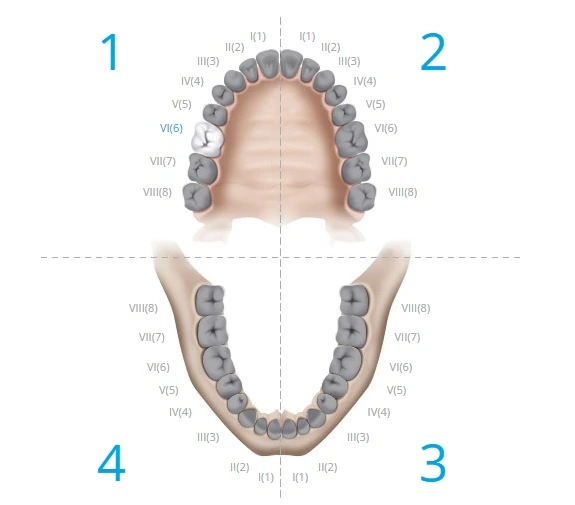
Table when permanent teeth appear: